
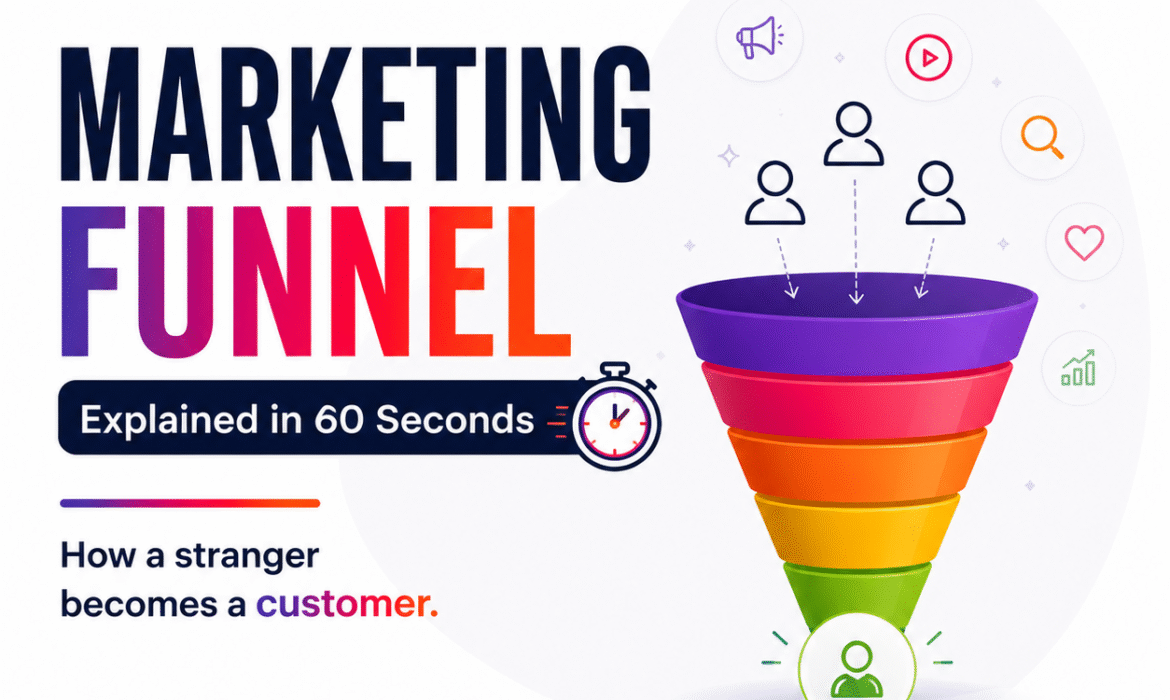
Marketing Funnel Explained: A Complete Guide to Turning Strangers Into Customers
Every customer journey starts somewhere.
Someone discovers your brand on Instagram.
Someone searches for your service on Google.
Someone sees your advertisement.
Someone hears about your business from a friend.
But seeing your brand doesn’t automatically mean becoming a customer.
There is a journey between “I don’t know this business” and “I’m ready to buy from them.”
This journey is what we call the Marketing Funnel.
A marketing funnel helps businesses understand how people move from discovering a brand to becoming customers — and eventually, loyal customers.
In simple terms:
Awareness → Interest → Consideration → Conversion → Retention
Understanding this process can help businesses create better content, better campaigns and better customer experiences.
What Is a Marketing Funnel?
A marketing funnel is a framework that represents the different stages a potential customer goes through before and after making a purchase.
At the top of the funnel, you have a large audience who may not know your business yet.
As people move through the funnel, some become interested, some compare your business with competitors, and eventually a smaller percentage become customers.
After conversion, the goal is to retain those customers and encourage repeat business.
Think of it like this:
A stranger discovers your brand.
↓
They become interested.
↓
They consider your offer.
↓
They make a purchase.
↓
They become a repeat customer.
This is why the marketing funnel is important.
Marketing isn’t just about getting attention. It’s about moving attention toward action.
Why Is a Marketing Funnel Important?
Many businesses make the mistake of treating every person as if they are ready to buy.
But customers aren’t always ready to purchase the first time they see your brand.
Imagine someone sees your Instagram advertisement for the first time.
They may think:
“Interesting.”
But that doesn’t mean:
“I want to buy this right now.”
They may need to:
- Learn more about your business
- Understand the product or service
- Compare alternatives
- Read reviews
- Check pricing
- Visit your website
- Build trust
- Talk to someone from your business
A marketing funnel helps businesses create content and campaigns for each stage of this journey.
The 5 Stages of a Marketing Funnel
1. Awareness — Get Attention
This is the top of the funnel.
At this stage, the customer may not even know your brand exists.
Your primary goal is:
Get Attention.
Businesses can create awareness through:
- YouTube
- Google Search
- Google Ads
- SEO
- Reels
- Influencer marketing
- Blogs
- Educational content
- Paid advertising
For example, someone scrolling Instagram may see a Reel about a problem your business solves.
They weren’t looking for your company.
But now they know you exist.
That’s awareness.
Marketing question:
“How do we get the right people to notice us?”
2. Interest — Build Curiosity
Once someone knows about your brand, the next step is generating interest.
The customer starts asking:
“Is this useful for me?”
At this stage, your content should provide value and answer questions.
You can use:
- Educational posts
- Reels
- Guides
- Blog articles
- Case studies
- Product demonstrations
- FAQs
- Explainer videos
For example, a digital marketing agency could create content explaining:
“5 Reasons Your Google Ads Aren’t Generating Leads.”
Someone facing this problem may stop scrolling and read the content.
They are no longer just aware of the agency.
They’re interested in the solution.
3. Consideration — Build Trust
This is where customers start comparing options.
They may ask:
“Why should I choose you?”
At this stage, your brand needs to provide evidence.
Customers may look at:
- Google reviews
- Testimonials
- Case studies
- Portfolio
- Website
- Pricing
- Results
- Client experience
- Social media presence
- Competitors
This is why online reputation and trust signals are so important.
A customer might discover your business through an advertisement, but before contacting you, they may search your name on Google.
If they find a professional website, positive reviews, useful content and strong social proof, their confidence can increase.
Marketing question:
“Why should the customer trust us?”
4. Conversion — Get the Customer
Now comes the stage businesses usually focus on the most:
Conversion.
The customer is ready to take action.
That action could be:
- Purchase a product
- Book an appointment
- Call the business
- Send a WhatsApp message
- Fill out a lead form
- Request a quotation
- Schedule a consultation
- Sign up for a service
At this stage, your Call to Action (CTA) becomes extremely important.
Instead of making the customer wonder what to do next, clearly guide them.
Examples:
Book Your Consultation
Get a Free Quote
Talk to Our Expert
Shop Now
Send Us a WhatsApp Message
The easier you make the next step, the smoother the conversion journey can become.
5. Retention — Turn Customers Into Repeat Customers
The funnel doesn’t end after the first purchase.
In fact, that’s where another important opportunity begins.
A happy customer can:
- Buy again
- Upgrade
- Recommend your business
- Leave a positive review
- Follow your social media
- Become a loyal customer
- Refer friends and family
This is called customer retention.
Businesses can encourage retention through:
- Follow-up messages
- Email marketing
- WhatsApp marketing
- Loyalty programs
- Special offers
- Customer support
- Personalized communication
- New product announcements
- Educational content
The goal is to move from:
One-time customer → Repeat customer → Loyal customer → Brand advocate
Marketing Funnel Example
Let’s take a simple example of a local salon.
Awareness
A potential customer sees an Instagram Reel:
“5 Haircare Mistakes That Damage Your Hair.”
They discover the salon.
Interest
They visit the salon’s Instagram profile and see haircare tips, services and before-and-after content.
Now they’re interested.
Consideration
They check:
- Google reviews
- Service prices
- Photos
- Location
- Customer feedback
They’re comparing the salon with alternatives.
Conversion
They click:
“Book Appointment.”
The customer becomes a paying customer.
Retention
After the appointment, the salon follows up, shares maintenance tips and reminds the customer about their next appointment.
The customer returns.
That’s the marketing funnel in action.
The Role of Digital Marketing in the Funnel
Different digital marketing channels can support different stages of the customer journey.
Social Media Marketing
Helps businesses build awareness, engagement and brand personality.
SEO
Helps potential customers discover your business when they actively search for information or solutions.
Google Ads
Can place your business in front of people with high purchase intent.
Performance Marketing
Allows businesses to reach targeted audiences and optimise campaigns based on measurable results.
Content Marketing
Educates customers and helps build authority and trust.
Website
Acts as an important destination where customers can learn about your business, evaluate your offer and take action.
Lead Generation
Helps businesses turn interest into qualified enquiries.
A strong marketing strategy doesn’t necessarily depend on one channel.
It connects multiple channels across the customer journey.
Why Businesses Lose Customers in the Funnel
A business may get thousands of impressions but very few customers.
Why?
Because there may be a problem somewhere in the funnel.
For example:
High Awareness + Low Interest
Your content gets views but doesn’t communicate a useful message.
High Interest + Low Consideration
People are interested but don’t find enough information or trust signals.
High Consideration + Low Conversion
Customers like your business but the CTA, offer or buying process isn’t strong enough.
High Conversion + Low Retention
People buy once but don’t have a reason to return.
This is why businesses shouldn’t only look at reach or followers.
They need to understand what happens at every stage.
How to Build a Better Marketing Funnel
A strong funnel starts with understanding your customer.
Ask:
1. Who is my target audience?
Understand their needs, problems, interests and buying behaviour.
2. What problem am I solving?
Your marketing should communicate the problem and the solution clearly.
3. Where does my audience spend time?
Choose platforms where your potential customers are actually active.
4. What content does each stage need?
Don’t show the same message to someone discovering your brand and someone ready to buy.
5. What builds trust?
Use reviews, testimonials, case studies, results and transparent information.
6. What is the next action?
Every stage should guide customers toward the next logical step.
The Biggest Marketing Funnel Mistake
One of the biggest mistakes businesses make is trying to sell too early.
Imagine meeting someone for the first time and immediately asking them to buy from you.
It doesn’t always work.
Customers often need time to:
Discover → Understand → Trust → Decide
That’s why educational and valuable content is important.
Your first interaction doesn’t always need to generate a sale.
Sometimes its job is simply to create awareness.
The next interaction can create interest.
The next can build trust.
And eventually, the customer may be ready to convert.
Marketing Funnel vs Sales Funnel
These terms are often used together, but there is a slight difference.
A marketing funnel generally focuses on attracting people, creating awareness, generating interest and nurturing potential customers.
A sales funnel focuses more specifically on moving qualified prospects toward a purchase.
In modern digital marketing, however, the two often overlap.
A successful customer journey requires both marketing and sales to work together.
How ASI Solutions Can Help Businesses Build Their Funnel
At ASI Solutions, we understand that digital marketing isn’t simply about getting likes or views.
The bigger objective is:
Turn attention into meaningful business results.
Our services can support different stages of the marketing funnel:
📱 Social Media Marketing
Build awareness and engage your target audience.
🎯 Performance Marketing
Reach the right people and drive measurable results.
🔎 SEO & Google Ads
Increase visibility and capture high-intent searches.
👥 Lead Generation
Turn interest into qualified business enquiries.
🌐 Website Designing
Create a professional online presence designed to support conversions.
💡 Branding & Strategy
Build a consistent brand identity and long-term marketing direction.
The goal is not simply to bring more people into the funnel.
The goal is to move the right people through it.
A stranger doesn’t usually become a customer in one step.
They discover you.
They become interested.
They evaluate you.
They build trust.
They take action.
And if you deliver a great experience, they come back.
That’s the power of a marketing funnel.
Awareness → Interest → Consideration → Conversion → Retention
So don’t just ask:
“How many people saw my ad?”
Ask:
“What happens after they see it?”
Because the real goal of marketing isn’t just to get attention.

